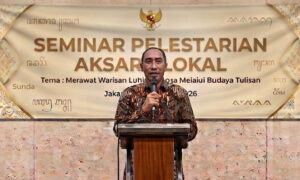
Tomi Serves as a Speaker on the Gholiks Script at a Seminar on Preserving Local Scripts
Jakarta, Metro Voice – The Organizing Committee of the Local Script Preservation Seminar successfully held a discussion forum on local Indonesian scripts. This event provided a platform to formulate strategic steps to save regional scripts in Indonesia from the threat of extinction.
One of the speakers at the seminar, Tomi, a researcher and inventor of the Gholiks script from Sanggau Regency, delivered an in-depth discussion on the existence of the Gholiks script. In his presentation, Tomi emphasized that local scripts are not merely symbols of written history, but rather reflections of the identity, outlook on life, and track record of the civilization of their communities.
Tomi explained that communities capable of reading and writing the Gholiks script are becoming increasingly difficult to find due to the erosion of modernization and the dominance of the Latin alphabet.
“When a script ceases to be used, we not only lose the writing system, but also the gateway to understanding the literature, mantras, history, and values of wisdom contained within. We must act before this script truly becomes a dead artifact,” Tomi emphasized to the seminar participants.
Three Strategic Steps to Save the Gholiks Script
To save the Gholiks Script, Tomi formulated three concrete and adaptive solutions to prevent it from becoming extinct due to changing times:
- Digitization and Unicode Standardization: Encourage the creation of a standard Unicode-based font so that the Gholiks Script can be technically accessed on various digital devices such as smartphones, computers, and social media platforms.
- Integration of Creative Education: Transforming teaching methods from rigid doctrinal methods to interactive media through the creation of comics, educational games, and visual content on social media platforms.
- Activation of Public Spaces and Communities: Encouraging the use of the script in everyday life through the formation of local literacy clubs and their implementation on signage in public spaces and public facilities.
About the Gholiks Script
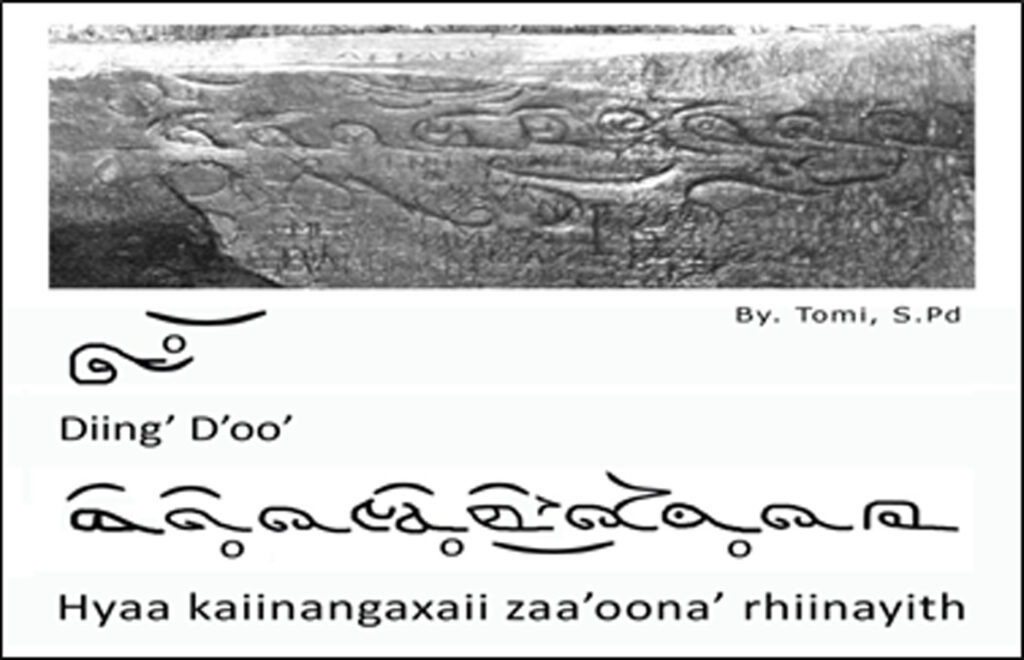
The Gholiks script is a rock-writing system found on stone carvings in Batu Pahat, Nanga Mahap, Sekadau Regency, and Batu Sampai, Tanjung Sekayam, Sanggau Regency. The word “Gholiks” is derived from the word “Gholij,” meaning “stone” or “land,” and later became “Gholiks.”
The Gholiks are one of the oldest ethnic groups in Kalimantan. This tribe was once the largest in the Thang Raya region. They built their dwellings in rocky areas, their settlements towering and constructed of stone. When Mount Niut erupted, the Gholiks were separated.
The Gholiks script, as one of the legacy writing systems of the ancient people of Kalimantan, has a form and style that differs from other scripts found throughout the archipelago.
The Gholiks script even differs from the form and style of the seven Yupa inscriptions found in Muara Kaman, Kutai Regency, East Kalimantan. The Gholiks script is also distinct from the script form and style of the Turai Board, a legacy of the Iban people, which is now housed in the Sarawak Museum, Malaysia. The Gholiks script also differs from the Dunging script of the Iban people and the Gagarit script of the Kadazan Dusun people.
The Gholiks script found on the stone carvings at Batu Pahat and Batu Sampai, although derived from the same writing system and derived from the same languages, Sangen and Sangiang, differ in their writing styles. The Gholiks script carvings at Batu Pahat are an older writing style than the Gholiks script at Batu Sampai.
The writing style of the Gholiks script carvings at Batu Pahat tends to be irregular and consists primarily of symbols that do not form words or sentences. Each letter of the script stands alone and forms its own meaning. There is no punctuation, and some letters are broken off from one another.
The Gholiks script, found on the stone carvings at Batu Sampai, is a much younger writing style than the one found at Batu Pahat. The carved letters form interconnected words and sentences. Punctuation is present, meaning letters are combined with signs to form the sounds of a word, making it easier to understand the meaning of the letters carved on Batu Sampai.
There are also stress marks and pauses within sentences. The writing tends to be regular, and the writing style of the letters has also created a kind of art form.
In general, the Gholiks script has a fairly large number of letters due to the wide variety of sounds in the Sangen or Sangiang languages. There is emphasis on the throat and a tendency toward nasal and sibilant sounds, making it quite difficult to imitate if you are not used to it or are not a native speaker. In certain alphabets that form specific words, there are connections between one alphabet and another. Similarly, punctuation marks are connected both between punctuation marks and between punctuation marks within alphabets.
In the Gholiks script, some alphabets function as consonants or consonants, while some punctuation marks function as vowels or vowels. There are also nasal consonants.
Nasal consonants are phonemes produced through the nasal cavity. In other words, they are the quality of sounds delivered through the nose or specifically by lowering the soft palate.
Some sounds involve closing the mouth, producing the sound either entirely or partially through the nose, or the basic sound is pronounced through both the nose and mouth simultaneously.
Furthermore, some alphabets have hissing sounds, which are softer sounds, similar to blowing or whispering.
The Gholiks script is written from left to right, similar to the Latin script.
Participant Enthusiasm and Future Hopes
The discussion session was interactive. Participants enthusiastically asked questions related to the techniques for reading the Gholiks script and the technical challenges involved in its digitization.
Through this seminar, Tomi’s presence as a resource person successfully introduced the Gholiks script and opened up a new perspective: preserving local scripts does not mean rejecting progress, but rather coexisting with it. The seminar concluded with an interactive discussion between participants and the resource person. The high level of enthusiasm was demonstrated by the participants, who committed to supporting the digitalization and sustainable learning of the Gholiks script. (Ed.)